Building a horticultural lab in a back garden
Why a flatpack greenhouse, a Raspberry Pi and a handful of sensors are about to become my research station.
It started with a glass case. The Tokyo artist Azuma Makoto builds sealed, machine-tended homes for bonsai: misting systems, drip-fed water, fans for wind, lights, even speakers playing music to the trees. They're a modern take on the Victorian Wardian case, and the first time I saw one I wanted to build my own.
The more I read, the more the plan changed shape. This is where it has landed, and why.
Why not just build the tank?
My trees are temperate: Japanese pines, a Scots pine and several maples. Trees like these can't live permanently in a warm, sealed box. They need a proper winter dormancy, a lot of light, and moving air. Pines in particular pick up needle fungus in still, damp conditions. A year-round sealed chamber for a pine is really a research-grade growth cabinet with compressor cooling, and that's a project for later.
So the display case becomes something trees visit for a few weeks at a time, which is closer to how Azuma's exhibition pieces actually work. The real lab is the space around it.
The greenhouse
I have a flatpack greenhouse, 6 by 10 feet, still in its boxes, and a south-facing garden. The plan is to run the long side east to west, close to the house so nothing shades it in winter.
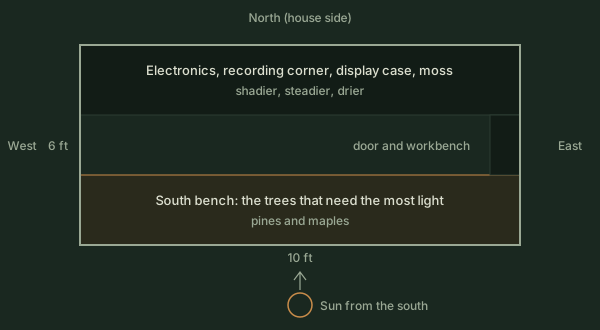
The plan from above. The door goes on the east end, because the west end takes the hot afternoon sun.
A south-facing greenhouse overheats fast, even in Ireland, so the essentials go in from day one:
- Automatic vent openers of the wax-cylinder kind, which need no power at all.
- Shade netting for summer, and a circulation fan to keep air moving.
- A frost-protection heater on a thermostat for the coldest nights.
- A solid, anchored base, because Irish gales take greenhouses personally.
Power will go in on an RCD-protected supply fitted by a registered electrician, with a network cable laid in the same trench.
What it will measure
The point of a lab is data. The first set of sensors covers the basics:
- Air temperature and humidity, using sensors that stay accurate in very damp air.
- Soil moisture and root-zone temperature.
- Carbon dioxide, and light levels across the spectrum.
- A leak sensor, because water and electronics share the space.
- A camera for an hourly timelapse, so a year of growth can be watched in a minute.
The brains
Small ESP32 boards in sealed, weatherproof boxes read the sensors and send the readings to Home Assistant, running on a Raspberry Pi. It's free, open source and runs entirely locally, so the lab never needs to be exposed to the internet. The same system can switch fans, misters and lights, with sensible limits, such as misting when humidity drops below a set level and stopping once it recovers.
Listening to trees
This is the part I'm most curious about. Plants have no brain, but they do produce measurable signals. Tiny electrical changes pass through leaves and stems in response to light, touch and damage. And a thirsty tree clicks: when the water columns inside its xylem snap under drought tension, they give off mostly ultrasonic sounds. Foresters have used this cavitation as a drought signal for a long time.
Recording these properly takes more care than you'd think. Mains electricity swamps the electrical signals, and the sounds are mostly above human hearing. Getting a clean reading will be its own series of articles.
A note of honesty: there are gadgets that turn plant signals into music. That's sonification, not a tree talking. The science here is interesting enough without dressing it up.
The first experiments
Nothing grand to begin with. First, one maple, logged every few minutes for a week, to prove the whole chain works. Then two trees of the same species with one thing changed between them, whether water, light or airflow, to see what the numbers show. After that, the electrical work: switching a grow light on and off and watching for the tree's response.
What's next
The greenhouse needs building and its base needs laying before any of this happens, so the next article will probably involve a spirit level and some swearing. I'll write it all up here as it goes, mistakes included.